- English
- 中文版


Nikkei 225 Hits Record High: Strong AI Momentum, Three Key Risks to Watch
.jpg?height=93&quality=100)
On April 27, the Nikkei 225 (JPN225) closed above the 60,000 mark for the first time ever, setting a fresh all-time high and fully recovering all losses sustained since the outbreak of the Middle East conflict.
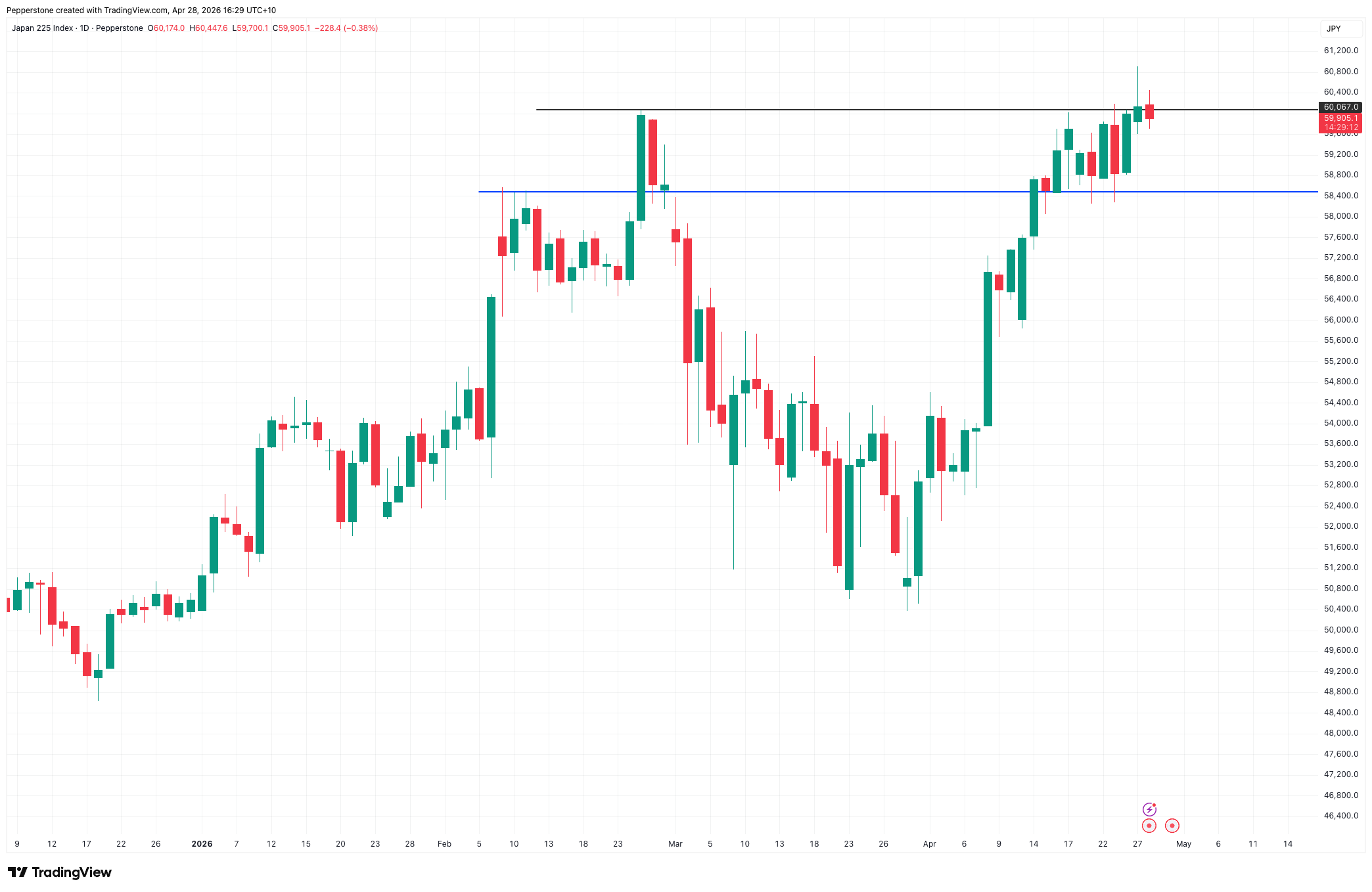
The rally has been led by the technology sector, against a backdrop of improving risk sentiment. Expectations of a gradual de-escalation in geopolitical tensions, the Bank of Japan's decision to hold rates, and seasonal fund flows provided additional tailwinds.
Record highs are undoubtedly cause for optimism — but elevated prices are also where risks tend to quietly build. Whether this rally can sustain itself, and what could derail it, are the questions traders need to be asking right now.
AI Chip Demand Surges — and Japan Is Winning
The Nikkei's advance has its origins across the Pacific. With traders pricing geopolitical escalation as a tail risk, confidence in the earnings power of US tech firms has remained firm, propelling the S&P 500 and Nasdaq to successive record highs. That improvement in risk appetite spilled over into Tokyo, turning the Nikkei into a leveraged play on the US AI wave.
Beyond sentiment, Japanese tech earnings have provided their own fundamental support. Advantest — the index's largest constituent at roughly 10% — gained 7% on the day, making an outsized contribution to the index's move.
The company's after-market FY2025 results were striking: net profit surged 133% year-on-year, and the FY2026 outlook was equally bullish. Management identified AI investment as the core growth driver and confirmed that capacity expansion is on track. The underlying business logic is straightforward and durable — virtually every AI chip must pass through Advantest's testing equipment before it ships. That demand is direct, stable, and not easily routed around.
Advantest was far from alone. Industrial automation giant Fanuc saw its shares spike 16% in a single session, driven by robust demand for its robotics business across China and the Americas. Tokyo Electron, Lasertec, Disco Corp, and Kioxia also posted meaningful gains.
The common thread is clear: as TSMC, Samsung, and others expand wafer capacity globally, a significant share of equipment procurement flows to Japan — converting global AI capex directly into order momentum for Japanese firms. Whether measured by sentiment, earnings, or the demand outlook, the technology sector is carrying this market.
Rate Hold and Foreign Inflows: The Hidden Pillars
Beyond the tech narrative, monetary policy and fund flows have played a quiet but important supporting role.
The Bank of Japan held rates at its April meeting. Although internal voting leaned hawkish — reflecting genuine inflation concerns — policymakers prioritised monitoring the potential economic fallout from the Middle East situation, opting to maintain a relatively accommodative stance for now.
The immediate effect was a release of yen appreciation pressure. For Japan's export-oriented industries — technology, autos, and beyond — that matters in a very tangible way: overseas revenues translate back into wider yen-denominated margins without any operational improvement required. Earnings expectations get a boost from the exchange rate alone.
The capital flows picture is equally supportive. Foreign investors account for around 70% of trading volume in the Nikkei 225, meaning their positioning largely sets the index's short-term direction. April marks the start of Japan's new fiscal year — a period when overseas active funds have a well-established pattern of seasonally adding exposure to Japanese equities.
That cyclical inflow landed precisely as AI-sector earnings were hitting their peak reporting window. The timing overlap is unlikely to be coincidental, and may go some way towards explaining why the index chose this moment to break to new highs.
Three Risks Worth Watching at These Levels
The bull case for the Nikkei is well-supported: sustained AI capex expansion, earnings validation, an accommodative policy backdrop, and seasonal foreign buying have all contributed to this run. But the more pressing question now is what could interrupt it.
Beyond the natural technical pressure of profit-taking at record highs, there are three specific risks worth monitoring closely.
The first is Middle East developments. Japan imports roughly 90% of its energy needs, giving oil prices an unusually direct line to corporate cost structures.
The Strait of Hormuz situation remains fluid — should talks collapse or tensions unexpectedly escalate, a sharp move higher in crude would compress Japanese corporate margins quickly. Even a prolonged stalemate, with oil staying elevated for longer, could gradually wear away at earnings and dampen the bull case for Japanese equities.
The second is the speed of yen depreciation. A weaker yen has been a tailwind for exporters, but if USD/JPY moves too quickly towards 160, the tolerance of the BOJ and Ministry of Finance is likely approaching its limits.
Whether the response comes through verbal intervention or an acceleration of rate hikes, a meaningful yen recovery would force a reassessment of earnings expectations for the export and tech sectors.
The third is US tech earnings. The quarterly results and capex guidance from US AI supply chain leaders are the most important forward indicator for Japanese semiconductor equipment demand.
If major players trim investment plans or strike a cautious tone in upcoming reports, that will feed directly into order expectations for Japanese equipment makers — and put the valuation support beneath the Nikkei's tech-heavy index under pressure. The flip side is equally true: continued bullish guidance would give the rally a fresh leg to stand on.
At these levels, opportunity and risk go hand in hand. Any shift in the variables above could have a real impact on open positions. For traders, clear entry and exit levels and disciplined position sizing remain the priority.
The material provided here has not been prepared in accordance with legal requirements designed to promote the independence of investment research and as such is considered to be a marketing communication. Whilst it is not subject to any prohibition on dealing ahead of the dissemination of investment research we will not seek to take any advantage before providing it to our clients.
Pepperstone doesn’t represent that the material provided here is accurate, current or complete, and therefore shouldn’t be relied upon as such. The information, whether from a third party or not, isn’t to be considered as a recommendation; or an offer to buy or sell; or the solicitation of an offer to buy or sell any security, financial product or instrument; or to participate in any particular trading strategy. It does not take into account readers’ financial situation or investment objectives. We advise any readers of this content to seek their own advice. Without the approval of Pepperstone, reproduction or redistribution of this information isn’t permitted.