- English
- 中文版


Bitcoin Reclaims $80K: Institutions Buy, Shorts Bail — Two Risks Could Derail
.jpg?height=93&quality=100)
On May 4, Bitcoin broke above the critical $80,000 resistance level, reaching its highest point since late January. With geopolitical tensions showing signs of escalation and technical indicators flagging potential profit-taking pressure, traders are asking: Is this a structural breakout or merely a short-squeeze-driven pop?
Five Weeks of Gains, One Critical Test: Is $80,000 the New Floor or a Ceiling?
Unlike the directionless, range-bound price action that characterised the early days of the geopolitical conflict in March, Bitcoin's upward trajectory became markedly clearer from April onwards.
The monthly gain exceeded 12%, marking the strongest performance since April 2025. A key backdrop to this shift was the market's gradual move away from pricing in extreme geopolitical scenarios, compounded by a broad recovery in risk assets providing beta-driven tailwinds.
After five consecutive weeks of gains accompanied by expanding volume, Bitcoin successfully reclaimed the $80,000 level. RSI surged from neutral territory a week prior to nearly 70, signalling dominant bullish momentum — though not yet in a classically overbought range.
From a technical standpoint, the market does not appear to be at a topping phase. It more closely resembles a critical confirmation point within a continuing trend, with $80,000 serving as the structural watershed.
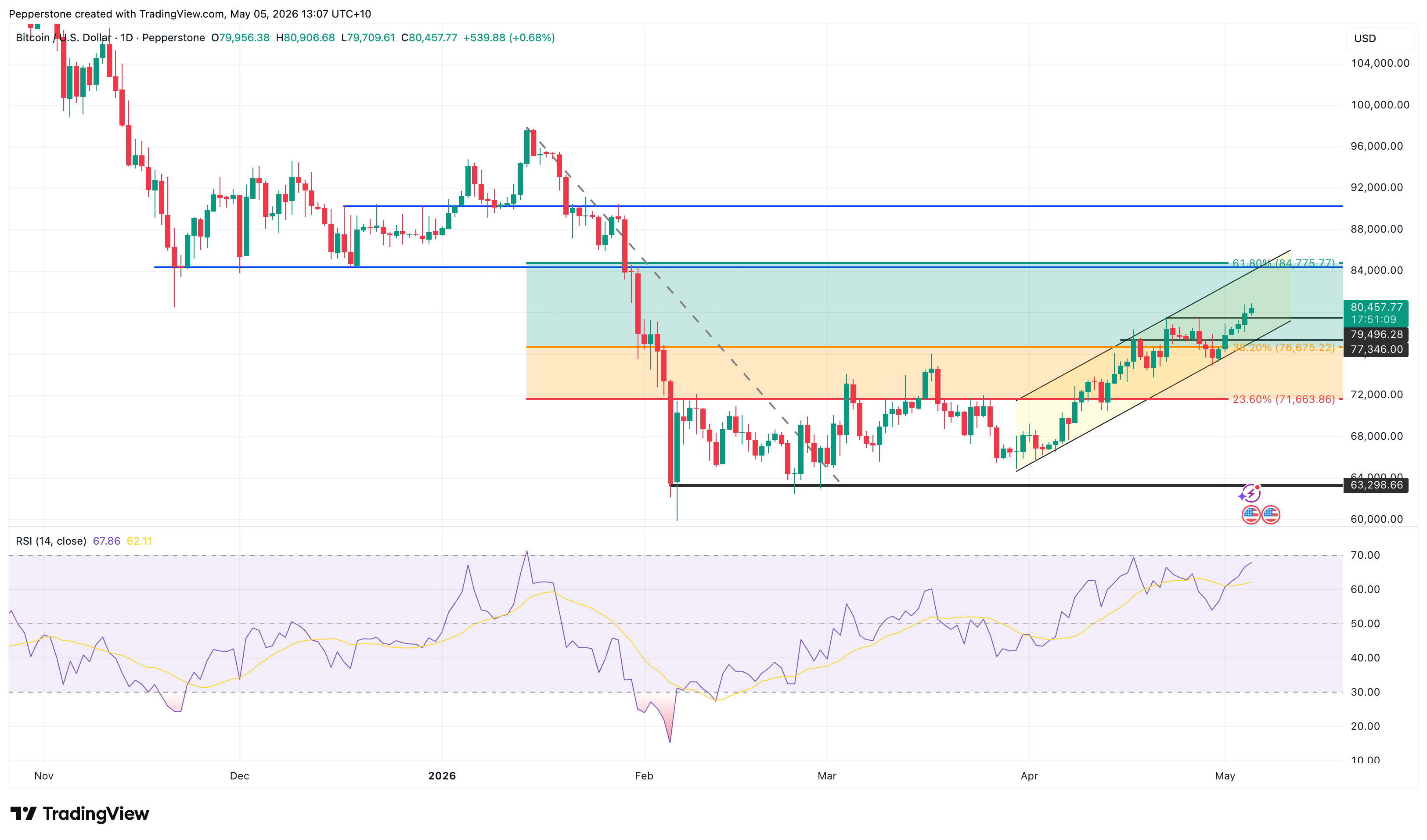
If bulls can hold their ground above this level, the next target is the $84,330–$84,775 zone — the 61.8% Fibonacci retracement of the mid-January downtrend, and a level that served as significant support through multiple tests in late 2025.
A decisive break above that zone would open the path toward $90,000, with the December consolidation high at $90,260 likely emerging as the next meaningful technical resistance.
Conversely, if $80,000 fails to hold, price action is more likely to revert to a consolidation structure. The $79,500–$80,000 zone would be the first level to absorb any pullback. A further leg lower could see buying interest emerge near $76,000 and the 23.6% retracement at $71,660.
Institutional Accumulation and Short Squeeze: The Anatomy of the Breakout
This breakout was not driven by a single catalyst. It was the result of supply-side contraction and a positional squeeze converging within the same window — then amplified by a geopolitical headline acting as the trigger.
First, large-scale institutional buying continued to provide structural support. According to SoSoValue data, led by BlackRock's IBIT and Fidelity's FBTC, global spot Bitcoin ETFs recorded net inflows for five consecutive weeks, totalling approximately $1.97 billion.
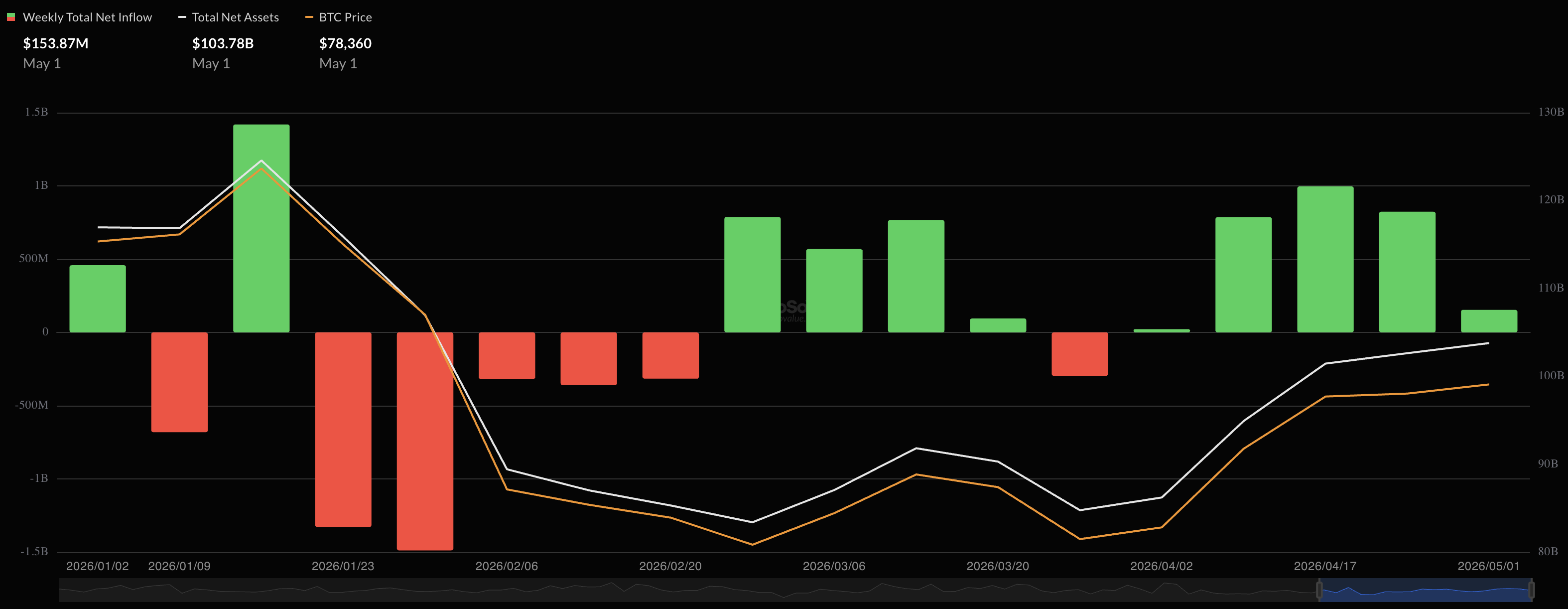
At the same time, Morgan Stanley's Bitcoin ETF (MSBT), which launched on April 8, attracted approximately $194 million in net inflows within its first month — with no single day of outflows recorded. The sustained pace of institutional capital entry has provided Bitcoin with meaningful underlying support.
Second, continued tightening on the supply side amplified price sensitivity. Strategy currently holds approximately 818,334 BTC. Although the company paused its purchases ahead of its earnings release, its prior accumulation has consistently compressed circulating supply, making prices increasingly responsive to incremental buying pressure.
Against this tightening supply-demand backdrop, the most immediate amplifier of Bitcoin's move came from a concentrated unwind of short positions. On May 4, President Trump announced "Project Freedom" — deploying naval assets to escort commercial vessels through the Strait of Hormuz. The announcement briefly eased fears of an uncontrolled escalation, prompting a rapid sentiment recovery that triggered the initial breakout.
Short positions heavily concentrated in the $75,000–$80,000 range were subsequently caught in a cascade of forced liquidations. On-chain data shows that over $150 million in crypto shorts were liquidated within one hour of the breakout, with 24-hour total liquidations reaching $304 million — of which Bitcoin accounted for $171 million.
Taken together, this breakout was underpinned by a relatively solid combination of institutional capital and market structure, providing a reasonably firm foundation for the move to continue.
Beyond $80,000: Three Factors Supporting Further Upside
Bitcoin's bullish momentum has yet to show signs of fading post-breakout. However, how much further the move can extend remains a question the market must now reassess.
In the near term, Bitcoin has rallied close to 30% since early March — despite persistent Middle East tensions and elevated oil prices — demonstrating a degree of resilience to external shocks. Given its risk-asset characteristics, broadly similar to equities, Bitcoin retains the conditions for continued upside provided the macro environment does not deteriorate materially.
Over a longer timeframe, the contrast between price and institutional behaviour is telling. From the October 2025 peak to the March 2026 trough, Bitcoin fell approximately 50%, yet spot ETF AUM declined by only around 7%. This divergence makes clear that institutional capital has not undergone a systematic exit — it is positioned for long-term structural allocation, not short-term trading.
On the regulatory front, Coinbase recently confirmed that it has reached a key agreement with senators on provisions relating to stablecoin yield. With the primary obstacle to advancing the CLARITY Act through the Senate now removed, sentiment around regulatory clarity for crypto has improved further.
Whether viewed through the lens of geopolitical resilience, the stability of institutional positioning, or improving regulatory expectations — the path of least resistance for Bitcoin continues to point higher.
Geopolitical Developments and Strategy's Guidance: Two Risks to Monitor Closely
Despite the current confluence of supportive conditions, whether $80,000 holds as a floor depends on whether genuine spot demand can sustain the move — not on short-term leverage or sentiment alone. In the near term, two key risk events warrant close attention from traders.
First, the US-Iran standoff remains unresolved. Bitcoin has demonstrated a degree of independent pricing capability, but it is not fully insulated from broader liquidity conditions under extreme scenarios. Should an escalation trigger a broad risk-off selloff, near-term capital outflows could push prices back toward key support zones.
Second, the pace of institutional accumulation requires validation. Strategy is set to report its Q1 2026 results after market close on May 5. Given Bitcoin's sharp pullback during the quarter, the company is likely to report a substantial unrealised loss on its holdings.
Markets, however, are less focused on the headline figures and more on whether management reaffirms its commitment to continued Bitcoin accumulation.
If balance sheet constraints or capital allocation pressures lead the company to slow or pause its buying programme, the market's most significant source of structural demand would face a meaningful reassessment — creating headwinds for Bitcoin in the near term. Conversely, a reaffirmed commitment to accumulation would provide continued support.
Related articles

The material provided here has not been prepared in accordance with legal requirements designed to promote the independence of investment research and as such is considered to be a marketing communication. Whilst it is not subject to any prohibition on dealing ahead of the dissemination of investment research we will not seek to take any advantage before providing it to our clients.
Pepperstone doesn’t represent that the material provided here is accurate, current or complete, and therefore shouldn’t be relied upon as such. The information, whether from a third party or not, isn’t to be considered as a recommendation; or an offer to buy or sell; or the solicitation of an offer to buy or sell any security, financial product or instrument; or to participate in any particular trading strategy. It does not take into account readers’ financial situation or investment objectives. We advise any readers of this content to seek their own advice. Without the approval of Pepperstone, reproduction or redistribution of this information isn’t permitted.